
Clayton County Arrest Records and Charges
Clayton County arrest records describe the arrest and custody event. That can include the person booked, the booking path, active custody status, and jail docket information kept by the Clayton County Sheriff's Office. The sheriff's public materials state that jail docket information is available online and that name search shows only active inmates. The office also maintains a printed jail docket book for public viewing. That custody source is useful, but it is not the same record as the charge filed in court.
Charges after arrest are tracked through the court system. Magistrate Court is the intake court in criminal cases, issues arrest and search warrants, sets bonds on most criminal charges, and conducts preliminary hearings. Superior Court handles felony cases prosecuted by the District Attorney, while State Court handles misdemeanors prosecuted by the Solicitor General. For the custody roster, use the Clayton County inmate records page. For pleas, disposition, and sentencing, use the Clayton County criminal court records page.
The source image for the Georgia Department of Corrections route is the GDC Find an Offender page.
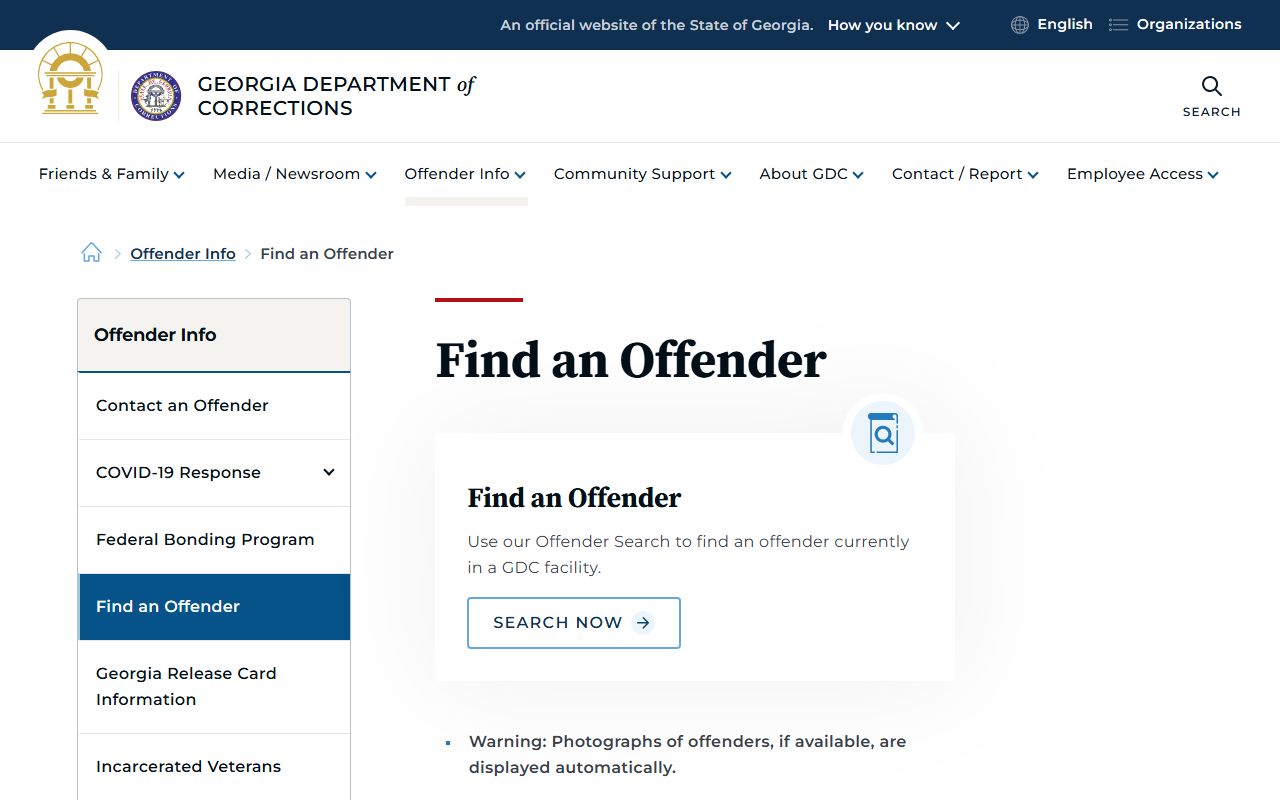
That state route matters after a Clayton County case results in a state sentence, but county arrest and court charge records still begin with local sheriff and court channels.
Find Clayton County Arrest Records
Official searching usually takes more than one stop. The Clayton County inmate search and the Sheriff's Jail Docket Inquiry help with custody and active inmate status. The Court Search Options page is the court path for criminal case charges in State Court, Magistrate Court, and Superior Court. If no public result appears, the record may be sealed, juvenile, restricted, older than the Judicial Information System entry period, or held by a municipal court rather than the county portal.
- Start with the sheriff inmate search when the question is current custody, booking date, or whether a person is active in the jail docket.
- Use the criminal name search when the question is whether a filed Clayton County charge has entered the court index.
- Search by case number if court paperwork lists the year, type, sequence, and optional division.
- Check the court and prosecutor path. Felony cases route through Superior Court and the District Attorney, while misdemeanors route through State Court and the Solicitor General.
- Use the Clayton County Open Records Request portal for non-published records that are not exempt from release.
Name search is not proof that no record exists. A person may be out of custody, charged under a case number not known to the searcher, held on a municipal matter, or listed in a restricted file. Certified copies and official court copies require clerk action rather than a search-result printout.
Clayton County also has split clerk routes. Superior and Magistrate case records route through the Clerk of Superior and Magistrate Court, while State Court misdemeanor and traffic records route through the Clerk of State Court. That split matters when the arrest began in Magistrate Court, but the later charge is prosecuted in State Court or Superior Court. If the case search result is incomplete, the next practical step is to identify the court named on the case, warrant, accusation, or indictment and contact that clerk division.
Clayton County Court Charges Filed
A charge record begins when a charging paper or court event creates the case file. Clayton County research identifies indictment as a grand jury charging document for felony prosecution and accusation as a prosecutor-filed charging document often used in State Court misdemeanors. Complaint is also a court term for an initial pleading, and in criminal intake it may be tied to warrant and probable-cause paperwork. The precise document depends on the court, case type, and prosecutor decision.
| Charging Paper | Typical Clayton County Use | What It Signals |
|---|---|---|
| Complaint or warrant paperwork | Magistrate Court intake, arrest warrant, search warrant, bond, or preliminary hearing context. | The case is at the probable-cause or intake stage after arrest. |
| Accusation | Often used for State Court misdemeanor prosecution by the Solicitor General. | The prosecutor has filed formal misdemeanor charges in court. |
| Indictment | Grand jury charging document for felony prosecution in Superior Court. | A felony charge has moved into the Superior Court case track. |
The county's District Attorney page names the DA as the felony prosecutor for Superior Court cases. The Solicitor General handles misdemeanor and traffic prosecutions in State Court. Those offices do not replace the clerk's court index, but they explain why one arrest can later appear in a different court and under a different case record.
Clayton County's Public Defender page adds another practical record path. A person charged with a felony or felony probation in the Clayton Judicial Circuit may submit an application to determine qualification for appointed representation under Georgia law. That office is not a public records counter, but its role helps explain why charge records, bond matters, and court dates should be read as active court events, not just background-history entries.
The source image for local correctional placement is the GDC Clayton County Correctional Institution page.
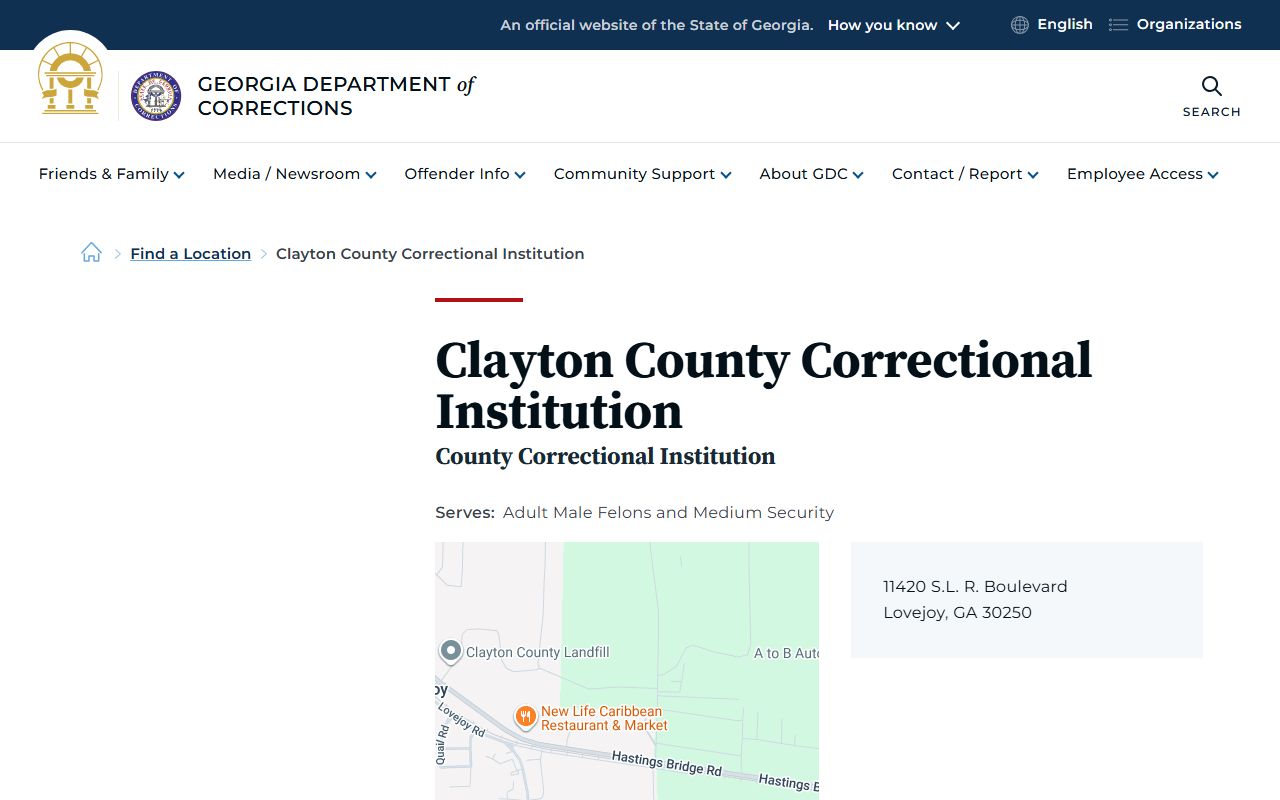
That page is a reminder that a Clayton County arrest can lead to different custody routes once a court case reaches sentencing.
Clayton County Charge Status Terms
Charge status can change as a case moves from arrest, to intake, to prosecution, to disposition. A court record may show an initial charge that was later amended or reduced. It may also show that a charge was dismissed or resolved by plea. The public case index may not expose every detailed field without a known case, so charge status should be read with the court, case number, docket entries, and final disposition together.
| Status | What It Means | Where To Confirm |
|---|---|---|
| Pending | The charge has not reached final disposition. | Court docket, clerk records, or prosecutor office. |
| Amended or reduced | The filed charge changed during prosecution or plea negotiation. | Docket entries and the final charging document. |
| Dismissed | The charge was ended without a conviction on that count. | Disposition field or court order. |
| Nolle prosequi | The prosecutor declined to continue that charge. | Disposition entry in the criminal case record. |
Note: A dismissed charge can still appear in a court history unless it is sealed, restricted, or otherwise removed from public access.
Clayton County Charges vs Convictions
Being arrested or charged is not the same as being convicted. Clayton County court records can show the accusation stage, the warrant path, the bond setting, the preliminary hearing, the plea, and the final sentence. A conviction means there has been a guilty plea, verdict, or other finding that supports judgment. Until the case reaches that point, the record describes allegations and court process.
| Point of Comparison | Charge | Conviction |
|---|---|---|
| Record stage | Filed after arrest or prosecutor review. | Entered after plea, verdict, or finding. |
| Meaning | An allegation in a criminal case. | A court outcome on guilt. |
| May change? | Yes, charges may be amended, reduced, or dismissed. | The sentence or probation terms may still be reflected later. |
| Main source | Magistrate, State, or Superior Court charge record. | Final disposition and sentencing record. |
State Routes After Clayton County Charges
Statewide sources are useful only for the part they actually cover. The Georgia Department of Corrections Find an Offender search is for state sentenced offenders, not every person arrested in Clayton County. A person held in the county jail before trial should be checked through the sheriff and jail docket route instead. Court charges stay with the county court record unless the person moves into state custody after a sentence.
The source image for prison phone rules is the Clayton County Prison phone system page.
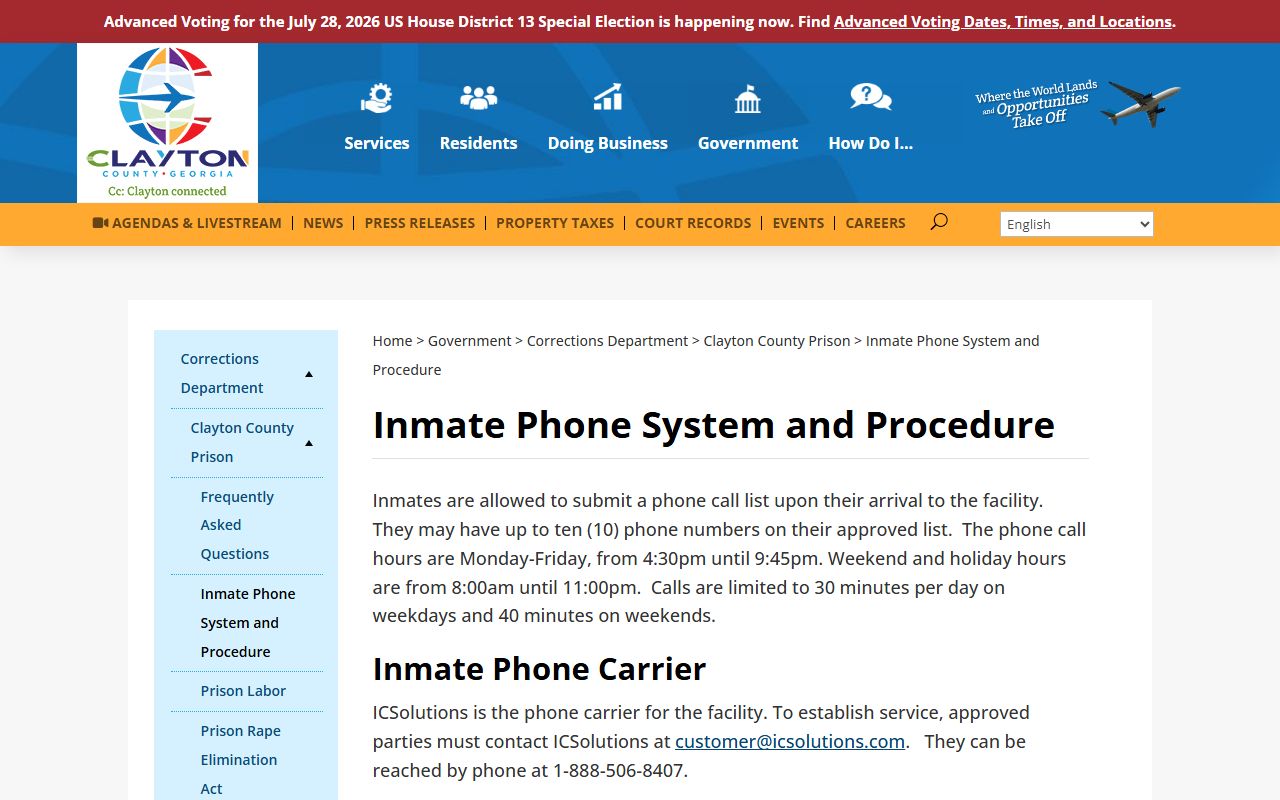
Phone and prison rules apply to sentenced prison custody, while arrest records and filed charges require sheriff, court, and prosecutor sources.
Restricted Clayton County Arrest Records
Georgia public access starts with the presumption that public records are open unless a law or court order limits access. The Georgia Open Records Act and Uniform Superior Court Rule 21 support public inspection, but they do not make every arrest, charge, or court record visible in every setting. Clayton County's court search excludes sealed cases, juvenile cases, adoption, probate in the main search, protective orders, restricted matters, older pre-JIS cases, and non-Clayton cases.
| Access Limit | Clayton County Effect |
|---|---|
| Juvenile records | Separated from adult court records and often confidential under Georgia juvenile-record laws. |
| Sealed cases | Hidden from ordinary public search unless party authority or a court order permits access. |
| Record restriction | Georgia's process can limit certain criminal-history records for non-criminal-justice purposes. |
| Active investigation | Some law-enforcement material may be withheld or redacted under open-records exemptions. |
The source image for inmate funds is the Clayton County Prison money page.
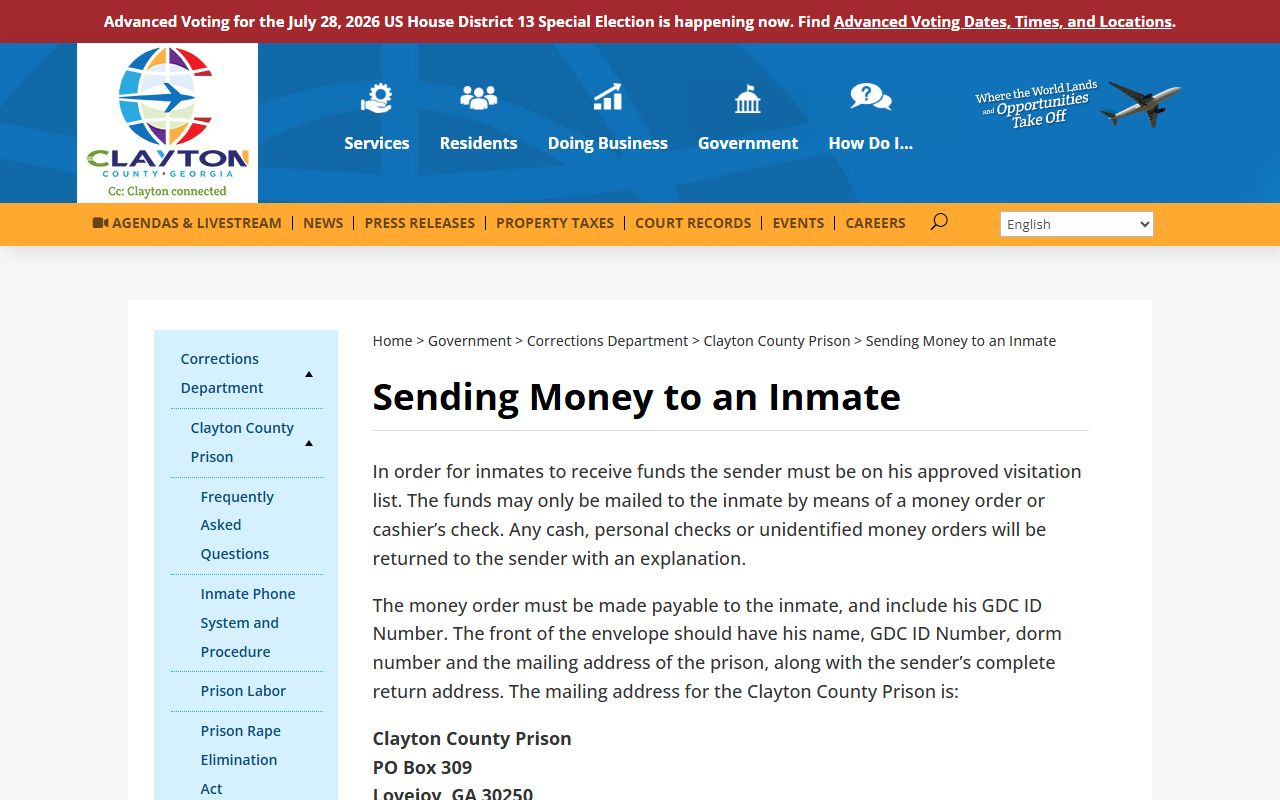
Custody rules, prison rules, and open court records serve different purposes, so the source should match the record being checked.
Record restriction is especially important for arrest and charge searches. Georgia uses the term record restriction for many criminal-history limits, and the research cites O.C.G.A. Section 35-3-37 through Georgia Courts. In Clayton County, the practical path can depend on whether the issue is an arrest, a prosecutor decision, a misdemeanor conviction, or a sealed court file. Some restrictions may limit public or employer access while still leaving criminal-justice access in place.
Drug Court has a local caveat. Clayton County's Drug Court materials state that participants must plead guilty to current charges and that those charges cannot later be expunged from criminal records even after successful completion. That is a narrow program rule, but it shows why a court charge record should be checked in its exact case context before assuming a charge can be cleared from public view.
Important: Public charge information should be verified with the originating court before any legal, employment, housing, or licensing decision.